
Description
See what a plugin update changes before you install it. Patchmark compares the new version of a plugin or theme with the one on your site and shows every changed file as a diff, the changelog between the two versions, and any new code that deserves a second look. It also checks whether the files of your installed plugins have been modified, using the checksums WordPress.org publishes.
Use it to:
- Review plugin updates before updating. Every update on the Plugins screen gets a Review the changes first link.
- Compare two versions of a plugin or theme. Upload a zip of something already installed and get a full file comparison in place of WordPress’s small “replace current with uploaded” table.
- Check plugin file integrity. Find files that were modified, added or deleted since installation, the usual sign of a hacked site or a forgotten hotfix.
- Vet premium and custom plugins. Zips from a vendor, a marketplace or GitHub get the same review as updates from WordPress.org.
- Automate update checks. WP-CLI commands for deploy scripts and CI.
No settings, no account, nothing on the front end, and nothing is stored.
Review plugin updates before you install them
Click Review the changes first next to any plugin update. Patchmark downloads the update package, compares it with your installed copy and opens the review with Update in the top bar. When there are serious findings, updating takes a second click.
Compare a plugin or theme zip with the installed version
Upload a zip under Plugins › Add New › Upload Plugin or Appearance › Themes › Add New › Upload Theme. When that plugin or theme is already installed, Patchmark turns WordPress’s comparison screen into a review, with Replace and Cancel in the top bar. This works for upgrades, downgrades and rollbacks, and for premium plugins and themes.
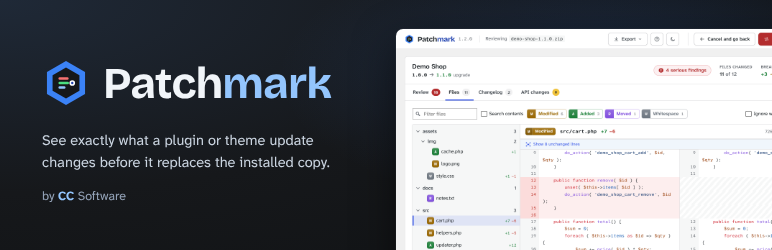
File diff viewer
- A folder tree of every added, removed, modified, renamed and whitespace-only file, with line counts.
- Side-by-side (split) or unified diff with syntax highlighting for PHP, JavaScript, TypeScript, CSS, SCSS, JSON, HTML, YAML, SQL, Markdown and more.
- Word-level highlights, folded context you can expand, and an option to ignore whitespace.
- Before and after previews for images.
- Filter by name or status, search inside the changed files, and step through files with j and k.
Security review of new code
Patchmark lists what is worth reading, most serious first, each finding linked to the exact file and line:
- Suspicious code that is new in this version: eval and decode-and-run, shell commands, includes and unserialize of request data, functions named by the request, obfuscated names, long encoded strings, PHP hidden inside an image or another file that isn’t PHP.
- New behavior: code that creates users or roles or grants capabilities, new outgoing requests, new web addresses and bare IP addresses, browser beacons, file writes.
- Unusual files: .htaccess and .user.ini, PHP with odd extensions (.phtml, .phar, image.jpg.php), PHP in image or font folders, executables, shell scripts, bundled archives.
- Header changes: an older version than installed, the same version with different files, a different name or author, a new Update URI (future updates would come from somewhere else), new requirements, a renamed main file.
- What it adds to the site: new scheduled events (cron), database tables and admin screens.
- Themes: a missing or changed parent theme, and whether the theme is the one visitors see.
PHP is read with the tokenizer, so $db->exec() or “eval” in a comment is not mistaken for the real thing. Only code that was not in the installed copy of the same file is reported, which keeps the list short.
Changelog between versions
The entries from readme.txt or CHANGELOG.md between your version and the new one, plus the Upgrade Notice. For a downgrade, the entries you would give up.
API and breaking changes
Functions, classes, public methods, hooks (actions and filters), REST routes, shortcodes, post types, blocks, options and capabilities the new version adds or removes, plus Composer libraries that were added, removed or updated. Removed names are what breaks themes, snippets and other plugins that rely on them.
Plugin file integrity check
Tools › Patchmark verifies installed plugins against the official WordPress.org checksums (SHA-256 or MD5) and lists files that were modified, added or are missing. See what changed opens a diff of your copy against the original from WordPress.org, so you can see exactly what was altered.
WP-CLI
wp patchmark diff, `wp patchmark update` and `wp patchmark check` print the same findings as a table, JSON or Markdown, and exit with status 1 on serious findings.
Export and share
Save a review as an HTML report (opens in any browser, prints to PDF), as Markdown for a ticket or pull request, or as a git-style .patch that git apply applies to the installed copy.
Also included
- A dark theme, saved per user.
- A sample review and a guided tour, so you can try everything without a zip. The Live Preview button on this page opens it in WordPress Playground.
- Translation-ready.
Light and private
Nothing runs on the front end. Patchmark only steps in when there is something to compare, and only files that changed are read. Reviews are never stored: leaving the page discards them. The only thing saved is your light or dark choice.
A clean review is not a guarantee. Only install code from sources you trust.
External services
Patchmark makes requests only when you ask it to, with a click or a WP-CLI command:
- Review the changes first downloads the update package WordPress has already found for that plugin, from the same address WordPress would install it from. For plugins hosted on WordPress.org that is
https://downloads.wordpress.org/. For a plugin with its own updater (most premium plugins) it is that vendor’s server, and the address may carry your license key, exactly as it does when WordPress installs the update. Patchmark adds nothing to the request. - Check and Check all plugins on Tools › Patchmark download the checksum list for each plugin’s installed version from
https://downloads.wordpress.org/plugin-checksums/<slug>/<version>.json. - See what changed downloads WordPress.org’s zip of the installed version from
https://downloads.wordpress.org/plugin/<slug>.<version>.zip.
Plugins that are not from WordPress.org are never looked up there: the check says so and sends nothing.
The requests to WordPress.org carry the plugin slug and version in the address, and the headers WordPress sends with every request it makes (including your site’s address in the user agent). Nothing about your site’s content or users is sent. WordPress.org’s terms of service: https://wordpress.org/about/tos/ and privacy policy: https://wordpress.org/about/privacy/
Development
The files in build/ are compiled from TypeScript and SCSS but not minified, so you can read them as they are.
The source code and build setup are on GitHub: https://github.com/ClearanceClarence-Software/Patchmark
To build it yourself you need Node 20 or newer:
npm ci
npm run build

npm run zip makes the same plugin zip that's published here.<h3>Credits</h3>
Patchmark bundles the Bricolage Grotesque font (Copyright 2022 The Bricolage Grotesque Project Authors) and the Atkinson Hyperlegible Next and Atkinson Hyperlegible Mono fonts (Copyright 2020-2024 The Atkinson Hyperlegible Next / Mono Project Authors), all licensed under the SIL Open Font License 1.1. The license texts are in the licenses/ folder. The fonts are served from the plugin folder, not from Google.
Syntax highlighting uses Prism (https://prismjs.com), MIT license, bundled with the plugin.
Screenshots


Installation
- Install and activate Patchmark.
- Upload a zip of a plugin or theme you already have installed (Plugins › Add New › Upload Plugin, or Appearance › Themes › Add New › Upload Theme), or click Review the changes first next to a plugin update.
- Read the review, then choose Replace or Update, or Cancel, in its top bar.
- To check installed plugins against WordPress.org, go to Tools › Patchmark.
FAQ
-
How do I see what changed in a plugin update?
-
Go to the Plugins screen and click Review the changes first under the update notice. You get the changed files as a diff, the changelog between the two versions, and a list of new code worth reading. Then click Update, or leave the page to skip the update.
-
How do I check whether a plugin’s files have been modified or hacked?
-
Go to Tools › Patchmark and click Check all plugins. Each plugin from WordPress.org is compared with the official checksums for its version. Changed plugins list the modified, added and missing files, and See what changed shows the differences line by line.
-
Can I compare two versions of a plugin without installing either?
-
Yes, with WP-CLI:
wp patchmark diff old.zip new.zip. Each side can be a zip, a folder, or the folder name of an installed plugin or theme. -
Yes. Upload the new zip under Plugins › Add New (or Appearance › Themes › Add New) and Patchmark compares it with the installed copy. Premium plugins with their own updater usually get the Review the changes first link too, as long as WordPress has a download for the update. Only the integrity check needs WordPress.org, since that is where the checksums come from.
-
Can I use it to roll back or downgrade a plugin safely?
-
Patchmark shows what a downgrade would change and which changelog entries you would give up before you replace the installed copy. Replacing the files is done by WordPress, as usual.
-
Does it slow down my site?
-
No. Nothing loads on the front end, and in wp-admin Patchmark only runs on its own screens.
-
Can I try it without a zip?
-
Yes. Tools › Patchmark › See a sample review builds a review of a made-up plugin’s update in a temporary folder and removes it again. Nothing is installed. The Live Preview button on this page opens the same sample in WordPress Playground.
-
Where do I learn what everything does?
-
Tools › Patchmark › Guide (the question mark on that screen, or the Guide link under Patchmark on the Plugins screen) explains each part. On any review, the question mark in the top bar starts a short tour of the screen you’re looking at.
-
Where are the settings?
-
There are none. The review appears on the upload screen when it has something to compare, and the integrity check is under Tools › Patchmark.
-
Does it work for themes?
-
Yes, for theme zips you upload. Update reviews and the integrity check are for plugins, since WordPress.org only publishes checksums for plugins.
-
Which plugins can the integrity check verify?
-
Plugins hosted on WordPress.org, at a version WordPress.org still has. Premium plugins and plugins from GitHub show as “can’t check”; review their updates by uploading the zip.
-
How do I use it from the command line?
-
wp patchmark diff woocommerce ~/woocommerce.9.4.0.zip
wp patchmark diff ./old-folder ./new.zip –format=markdown > review.md
wp patchmark update akismet –fail-on=warn
wp patchmark check –all –diffEach side of
diffcan be a folder, a zip, or the folder name of an installed plugin or theme.--formatis table, json or markdown. The commands exit with status 1 when there are serious findings (or, forcheck, changed plugins). -
How large a plugin can it handle?
-
Plugins with up to 20,000 files. A plugin like Formidable Forms (about 1,800 files, 29 MB) is compared in well under a second. Files over 512 KB, and anything past 8 MB of changed text, are compared and checked but their contents are not shown, to keep the page light.
-
Is the code check a malware scanner?
-
No. It points at changes worth reading. It can’t prove a plugin is safe, and it reports things that are normal in some plugins (a membership plugin creates users).
Reviews
There are no reviews for this plugin.
Contributors & Developers
“Patchmark – Compare Plugin Updates & Check File Integrity” is open source software. The following people have contributed to this plugin.
Contributors
Translate “Patchmark – Compare Plugin Updates & Check File Integrity” into your language.
Interested in development?
Browse the code, check out the SVN repository, or subscribe to the development log by RSS.
Changelog
1.2.1
- Security: every folder in the new copy is now compared. Folders named like working-copy clutter (node_modules, .git, .idea and others) used to be skipped, so code placed there was not shown or scanned. They are now only left out of the installed copy, and only when the new copy has no such folder. The integrity check skips nothing.
- New checks: PHP code inside an image or another file that isn’t PHP, includes of such files or of an address, functions named by the request, functions held in a variable and fed request data, function names glued together from strings, callbacks passed to call_user_func() and similar, and bare IP addresses.
- New checks: file_get_contents(), fopen() and curl_init() with an address count as outgoing requests; fwrite(), unlink(), rename() and copy() count as file changes.
- Fixed: the integrity check no longer compares a plugin that isn’t from WordPress.org with a WordPress.org plugin that happens to use the same folder name.
- Fixed: the .patch download left out a file whose only change was the newline at its end.
- Changed: the integrity check uses SHA-256 when WordPress.org provides it.
- Changed: temporary folders are removed when a request times out or fails, and leftovers are swept up after an hour.
- Changed: large plugins get more time and memory to compare.
- Changed: an error in one file or tab no longer blanks the whole review.
- Changed: deleting Patchmark removes each user’s saved light or dark theme.
- Changed: the status for a moved file is called Renamed everywhere, matching its R badge.
1.2.0
- New: a guide under Tools › Patchmark › Guide that explains every part of Patchmark.
- New: a guided tour of the review. Start it with the question mark in the top bar, or from the guide on the sample review.
- New: the sample review is a much fuller example: a major update with renamed and removed functions, hooks and shortcodes, a new block, REST route and libraries, and the kind of changes Patchmark exists to catch.
- New: blocks registered from block.json are listed in API changes.
- Changed: the header comparison lists changed fields first, as old new with a tag (Upgrade, Downgrade, Raised, Lowered, Added, Removed, Changed), and folds the unchanged ones away.
- Changed: new solid file status badges, easier to tell apart in both themes. The file tree shows the letter (A, M, D, R, W), the diff header shows letter and word (A | Added), and the file filters are color-coded tags.
- Fixed: the Export and theme buttons in the top bar line up with the other buttons.
1.1.0
- New: themes. Uploading a zip for an installed theme gets the same review, with checks for a missing or changed parent theme and the active theme.
- New: review updates from WordPress.org before installing them, from a link in each update row on the Plugins screen.
- New: Tools › Patchmark checks installed plugins against WordPress.org’s checksums, and compares a changed plugin with WordPress.org’s original.
- New: WP-CLI commands
wp patchmark diff,updateandcheck, with table, JSON and Markdown output and an exit status for CI. - New: export a review as an HTML report or Markdown, next to the .patch download.
- New: dark theme, saved per user.
- New checks: names hidden in escapes or chr() chains, minified PHP, preg_replace /e, strrev, add_cap(), navigator.sendBeacon(), and new scheduled events, database tables and admin screens.
- API changes now also list scheduled events, admin screens, database tables, options and capabilities.
- New: a sample review under Tools › Patchmark, and a Live Preview in WordPress Playground.
- A translation template is included, ready for translate.wordpress.org.
1.0.0
- First release: takes over the “already installed” upload screen with a review, a file browser with split and unified diffs, the changelog in between and API changes.